
PhotoRedOx Flow Reactor™

Screen easily with standardized format

Our original photoreactor with its patented design is compatible with most vial formats and its compact design allows for use with any stirring plate. A built-in fan keeps the reaction conditions at room temperature.

The choice for…
the chemist who seeks to standardize laboratory photochemical setups economically. A flexible design allows interchangable LED from 365 to 740 nm and a wide variety of vials.

Screen with double the workflow

The PhotoRedOx Duo uses the same patented concept as our original photoreactor but doubles the capacity and includes an additional reaction chamber. The Duo can hold double the capacity as the single box.

The choice for…
the chemist who seeks higher reaction capacity and increased light intensity than found in the PhotoRedOx Box.

Screen with Temperature Control

Based on the same design as the PhotoRedOx Box, the TC version with a standard chiller/heater unit (not included) makes it possible to perform photocatalytic reactions with temperatures controlled from 0°- 80°C.

The choice for…
the chemist who wants control over the temperature of their reaction while keeping the flexibility and control of the PhotoRedOx Box.

Screen, batch,
and flow

The next generation in photoreactors. The first reactor to allow screen to scale, batch and flow in one device with unparrallel control over wavelength, light intensity and temperature control.

The choice for…
the chemist serious about understanding all the factors necessary to
take reaction from
screen to scale in batch and flow. The most advanced photoreactor available anywhere.

Take a closer look...

Check out the details

Questions?

We’re happy to connect–just be in touch!

Compare Models

Hepatochem develops LED photoreactors for research and development.

Compare our photoreactors and find out which one is right for you!

Built-in efficiencies make Hepatochem’s one of the best photoredox flow reactors available.
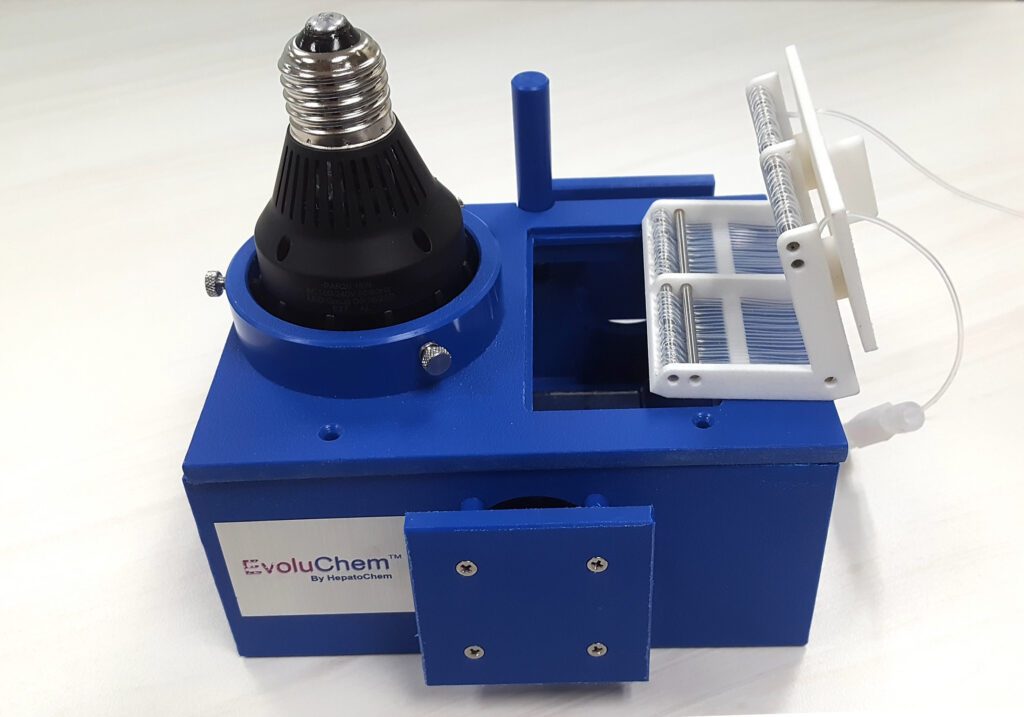
photoredox flow reactors

The common limitation to scaling up photoredox chemistry is due to the low penetration of the light in to the reaction mixture (few mm) which prohibits the use of large reaction vessels. Surface area is key to shorten reaction time. It is possible to significantly increase the surface area by running the reaction in flow. This will decreases the reaction time and allows to be run in continuous mode for scale-up.

To solve this challenge, we designed a flow reactor that can be used in the PhotoRedOx Box™. This flow reactor is using PFA tubing and has volume of 2 ml. Comparing reactions in flow and in batch we observed significant decrease in reaction time.
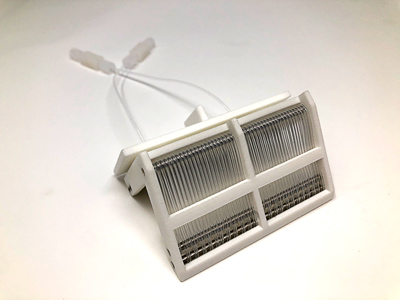
photoredox flow reactors
Photoredox Flow Reactor

HCK1006-01-022
(Patent Pending)

Photoredox Flow Reactor Validation Reaction 1

Aniline_Et3N

Time to 95% conversion: Flow 30 min, batch 24h

Reaction Protocol:
In a 4-ml vial equipped with a Teflon septa were weighed NiCl2-dme (1.1 mg, 5 μmol, 5 mol %) and dtbbpy (1.3 mg, 5 μmol, 5 mol %). 1 ml of dry MeOH was added to the vial and the vial was stirred on an orbital shaker until complete dissolution. The solution was evaporated to dry at room temperature. Then Ir(dF-CF3-ppy)2(dtbpy) (1.1 mg, 1 μmol, 1 mol %), and 4-bromoacetophenone (9.95 mg, 100 μmol, 1 equiv.) were added. 1 ml of dry acetonitrile was added followed by Et3N (21 μmol, 300 μmol, 3 equiv.) and aniline (4.65 mg, 100 μmol, 1 equiv.). The solution was sparged with nitrogen via submerged needle for 5 minutes.

Several batches of 100 μl of solution were successively injected to the flow reactor placed in EvoluChem PhotoRedOx Box with blue Kessil LED using an injection module (Gilson) and the samples were circulated using a HLPC pump at different flow rates to allow residence time of 5, 10, 15, 20 and 30 min. Reaction completion was monitored by LC-MS using the ratio bromoacetophenone/product.


Flow Reactor Validation Reaction 2
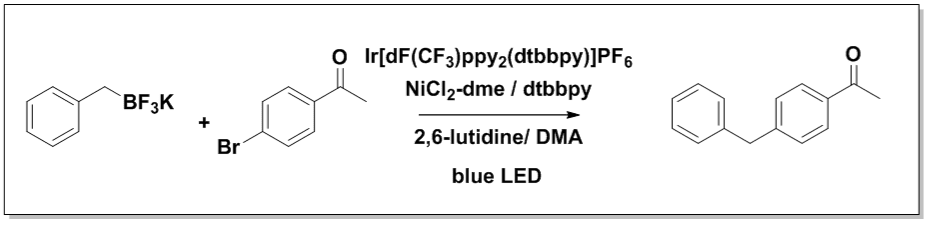
Molander_Lutidine

Time to 95% conversion: Flow 30 min, batch 8h

Reaction Protocol:
In a 4-ml vial equipped with a Teflon septa were weighed NiCl2-dme (1.1 mg, 5 μmol, 0.1 mol %) and dtbbpy (1.3 mg, 5 μmol, 0.1 mol %). 1 ml of dry MeOH was added to the vial and the vial was stirred on an orbital shaker until complete dissolution. The solution was evaporated to dry at room temperature. Then Ir(dF-CF3-ppy)2(dtbpy) (1.1 mg, 1 μmol, 0.1 mol %), and 4-bromoacetophenone (4.98 mg, 50 μmol, 1 equiv.) were added. 1 ml of dry acetonitrile was added followed by 2,6 lutidine (17.5 μmol, 150 μmol, 3 equiv.) and potassium benzyltrifluoroborate (9.90 mg, 50 μmol, 1 equiv.). The solution was sparged with nitrogen via submerged needle for 5 minutes.

Several batches of 100 μl of solution were successively injected to the flow reactor placed in EvoluChem PhotoRedOx Box™ with blue Kessil LED using an injection module (Gilson) and the samples were circulated using a HLPC pump to allow residence time of 30 min. Reaction completion was monitored by LC-MS using the ratio bromoacetophenone/product.

Check our photoreactor suite

A novel cyanomethylation method using the Lucent360™
The Lucent360™ is the most complete photochemical reactor available for controlling and screening reaction parameters;  wavelength, light intensity, reaction...
2025 photochemistry review
2025 Photochemistry Year in Review
Our 25 favorite photochemistry papers from 2025  Happy New Year from all of us at HepatoChem.  Before we move forward into another great year, let’s take a look back at...
Red emergency light flashing in the dark.
A Nickel for a Red Light

Discover the power of red light in photochemistry! Explore recent advances in red LED-driven synthesis, from C-N coupling – protein labeling.

2024 Photochemistry
2024 Photochemistry Year in Review

Looking back on the past year in photochemistry, we want to recognize 24 of our favorite papers from 2024 that tickled our brains.

Pulsed-Light photochemistry
Pulsed-Light Photochemistry: Yes, No or Maybe?

Pulsing light in a photocatalysis reaction is like flipping on the strobe lights at a party—but can it shift the vibe enough to change outcomes? Inspired by a recent study, this month we take you for a spin on this experimental dance floor.

Photo Chemistry of the Rainbow
Photochemistry of the Rainbow: Synthesis from Purple to Red

This month, we look at purple and red LEDs and everything in between. The world is full of color so why is everyone so blue?

Lucent360
Catching up with the Lucent360™

At midyear 2024: we feature 3 papers, highlighting key uses for the Lucent360™: Reaction method development, Scale up in batch, and Photochemistry in flow.

Photocatalytic Radiolabeling
Photocatalytic Radiolabeling with 18F in Flow

Flow photochemistry in the PhotoRedOx Box™ is Hot as F! This month, we feature novel photoredox induced fluorination for radiolabeling a wide range of pharmaceutically relevant small molecules.

A man standing on the beach with his back turned.
Metal-free “metal-catalyzed” reactions: Serendipitous Impurities in Photocatalysis

A metal-free, metal-catalyzed reaction? Confused? Sounds like a contradiction? Chemistry is rife with examples of trace metal impurities playing an unwelcome (or occasionally key) role in transition metal catalysis.

A person holding an iphone with the homepage of a website.
Photochemistry Tutorials

From time to time, it’s useful to take a step back and look at some of the basics of photochemistry. This month we thought we would share a few of our favorite short quick reads, on fundamental photochemistry topics.

A cork board with pictures of dogs and computers.
2023 Photochemistry Year in Review

Here is our list of the 23 photochemistry papers that we thought were the best funniest oddest most interesting or downright unexpected of 2023.