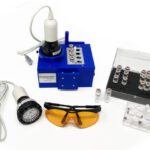
When comparing photochemistry LEDs, wattage is the wrong number to look at. What matters is how much light actually reaches your reaction – and on that measure, the EvoluChem 18 W PF LED consistently outperforms 40 W alternatives across the visible and UV spectrum.
A common question we receive from chemists evaluating photoredox LEDs goes something like this: “Your LED is 18 W and the Kessil is 40 W – doesn’t that mean the Kessil is more powerful?” It is a reasonable assumption, but it rests on a misconception about what wattage actually measures. The short answer is no – and the data back this up clearly.
What wattage actually measures
Wattage is a measure of electrical power consumption – how much energy the device draws from the wall. It says nothing about how efficiently that energy is converted into light, what wavelengths that light covers, or how much of it actually reaches the reaction vessel. Two light sources with identical wattage ratings can deliver dramatically different amounts of usable light to a sample, and two sources with different wattage ratings can deliver comparable or reversed amounts.
Think of it this way: a 60 W incandescent bulb and a 10 W LED can produce the same visible light output, because the LED converts electrical energy into photons far more efficiently. The LED wastes far less energy as heat. The same principle applies to photoredox LEDs – efficiency, beam geometry, and spectral focus all determine how much light reaches the sample, and wattage tells you none of these things.
For photochemistry, what actually drives a reaction is irradiance at the sample: the photon flux delivered to the reaction, typically measured in mW/cm². This is what initiates the photocatalytic cycle, determines reaction rate, and ultimately controls conversion. A light source that delivers more irradiance at the vial produces faster reactions, all else being equal.
Direct irradiance measurements: EvoluChem vs Kessil PR160
HepatoChem has directly measured and compared the irradiance delivered by the EvoluChem 18 W PF LED and the Kessil PR160 at multiple wavelengths using a calibrated photoradiometer probe at a standard distance of 2 cm. The results are unambiguous across the visible and UV spectrum:
| Wavelength | EvoluChem 18 W PF | Kessil PR160 (40 W) | EvoluChem advantage |
|---|---|---|---|
| 365 nm (near-UV) | 190 mW/cm² | 109 mW/cm² | +74% |
| 390 nm | 294 mW/cm² | 218 mW/cm² | +35% |
| 440 nm | 326 mW/cm² | 255 mW/cm² | +28% |
| 450 nm | 277 mW/cm² | 184 mW/cm² | +51% |
| 525 nm | 163 mW/cm² | 111 mW/cm² | +47% |
At every wavelength in this comparison, the 18 W EvoluChem PF LED delivers more irradiance to the sample than the 40 W Kessil PR160. The advantage ranges from 28% at 440 nm to 74% at 365 nm. The EvoluChem LED uses less than half the electrical power and still delivers substantially more light to the reaction.
The key differentiator is beam geometry. The EvoluChem PF LED is designed to concentrate irradiance toward the sample, delivering more photons directly to the reaction vessel. This focused beam design also maintains its advantage at greater working distances – irradiance falls off more slowly than in sources with a broader, less directed emission profile.
Real reaction data from AbbVie: 3× faster conversion
Internal irradiance measurements tell one part of the story. The other part comes from a peer-reviewed publication from the Advanced Chemistry Technologies Group at AbbVie, which conducted a systematic head-to-head comparison of light sources and photoreactors for Ni/Ir photoredox decarboxylative cross-coupling reactions.
The paper – “At the Speed of Light: The Systematic Implementation of Photoredox Cross-Coupling Reactions for Medicinal Chemistry Research” (Gesmundo, Rago, Young, Keess, Wang; J. Org. Chem. 2024, 89, 16070–16092) – measured percent conversion over time for a benchmark Ni/Ir cross-coupling reaction at 450 nm under identical conditions using different light sources. The results from the supplementary information are striking:
| Light source | 10 min | 30 min | 45 min | 90 min | 120 min |
|---|---|---|---|---|---|
| HepatoChem 18 W 450 nm | 44% | 98% | 100% | 100% | 100% |
| Kessil A160WE Blue | 16% | 27% | 40% | 79% | 99% |
| Kessil H150 Blue | 16% | 39% | 60% | 100% | 100% |
The HepatoChem 18 W LED reached full conversion in 45 minutes. The Kessil A160WE – a 40 W blue LED – required 120–180 minutes to reach the same endpoint. That is roughly a threefold difference in reaction time, independently measured and published by a major pharmaceutical research group with no commercial stake in either product.
The same paper went on to use the HepatoChem PhotoRedOx Box and PhotoRedOx Duo as the photoreactors of choice for their medicinal chemistry photoredox workflow, citing the reproducibility and throughput performance of the setup across a broad library of substrates.
What this means for your laboratory
Faster reactions are not merely a convenience. In a medicinal chemistry setting, a reaction that reaches full conversion in 45 minutes instead of 3 hours means more experiments per day, faster optimization cycles, and reduced photocatalyst loading requirements when time is less of a constraint. At the synthesis scale, it means better throughput from the same equipment with lower electricity consumption – the 18 W EvoluChem LED uses less than half the power of a 40 W Kessil while delivering better results.
Beyond 450 nm, the pattern holds across the near-UV and visible spectrum. For researchers running reactions in the near-UV (365 nm) for UV-sensitive substrates, or at 390 nm for Ir photocatalysts, or at 440–525 nm for the full range of common organic photocatalysts, the EvoluChem PF LED delivers measurably higher photon flux to the sample at every wavelength tested.
The EvoluChem PF LED range covers the full spectrum from 254 nm to 808 nm as discrete single-wavelength sources. Each LED is quality-controlled for irradiance before shipping. Dimmable versions (the HCK1012-05-xxx series) are available for applications that require finer control over photon flux, and are compatible with both the PhotoRedOx UV-Vis reactor and standard external LED dimmers.
Explore the EvoluChem PF LED Range
Single-wavelength LEDs from 254 nm to 808 nm. Measured, quality-controlled irradiance. Engineered for photochemistry.
Reference: N. J. Gesmundo, A. J. Rago, J. M. Young, S. Keess, Y. Wang, J. Org. Chem. 2024, 89, 16070–16092. DOI: 10.1021/acs.joc.3c02351
Irradiance measurements performed by HepatoChem using a calibrated photoradiometer at 2 cm distance. All measurements for EvoluChem 18 W PF LED vs Kessil PR160 (40 W).