A Photochemical Route to Non-Hallucinogenic 5-HT2A Ligands
A collaboration between the Mascal Lab at UC Davis, the McCorvy Lab at the Medical College of Wisconsin, and HepatoChem demonstrates how UV LEDs in the Lucent360™ transform a 60-year-old photocyclization into a practical tool for serotonin receptor drug discovery, accessing a previously inaccessible region of indole chemical space.

The problem: a useful reaction stuck in the mercury-lamp era
The Witkop photocyclization, discovered in 1966, builds an eight-membered lactam bridging the C3- and C4-positions of the indole nucleus. It is a rare way to directly functionalize indole at C4, an important position for medicinally active compounds, without protecting groups, directing groups, or transition metals.
Despite its appeal, the reaction has remained a curiosity rather than a synthetic tool. Classical conditions use low-pressure mercury lamps at 254 nm and suffer from three persistent problems:
- Low yields and poor selectivity: competing C2 cyclization and unproductive C–Cl homolysis dominate when α-haloacetyl tryptamides are used as substrates.
- Slow optimization: a single-vessel mercury reactor screens one condition at a time. Mapping a single parameter (acid, solvent, concentration, wavelength) can take weeks.
- Bulb lifetime: running condition screens consumes a meaningful fraction of the rated life of expensive low-pressure mercury bulbs.
For drug discovery, this combination has been disqualifying. Generations of chemists have walked past the Witkop cyclization because the cost of optimizing it has been higher than the value of the product.
The reaction
In their recent publication in the Journal of the American Chemical Society, Beckett, Buzdygon, Nguyen, and coworkers from the Mascal and McCorvy labs took a different approach. Rather than start with the classical α-chloroacetyl tryptamides, they coupled the 20 protein amino acids (plus norleucine, tert-leucine, and theanine) to tryptamine and irradiated the resulting protonated α-amino tryptamides directly in aqueous medium.
The substrate scope is broad: the team prepared more than 30 cyclized lactams, including N-methylated, 5-methoxy-substituted, and α,α-dimethylated tryptamine variants relevant to known serotonergic pharmacophores. A complementary α-acetoxytryptamide route, derived from the same amino acids extends the method to substrates where the amine route stalls.
How the Lucent360 made it possible
The team’s initial attempts to optimize the reaction in a standard Rayonet photoreactor were promising but slow. Optimizing a photochemical reaction in a single-vessel system means changing one variable, running the reaction, working it up, analyzing it, and starting over. With dozens of variables to investigate, this is a multi-month commitment.
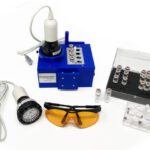
HepatoChem integrated 275 nm and 310 nm UV-LEDs into the Lucent360 specifically for this collaboration. The Lucent360’s geometry — 16 reaction vessels irradiated in parallel under matched conditions — collapsed each optimization study into a single 4-hour experiment.
A concrete example: the acid-effect screen described in Figure 1 of the paper, comparing HCl, TFA, and acetic acid at multiple equivalents, was completed in a single 4-hour Lucent360 run. The authors state that acquiring the same dataset with a single-vessel mercury lamp setup would have required 15 days of irradiation time more than 10% of the rated bulb life.
The Lucent360 enabled the team to systematically optimize:
- Acid additive: HCl and TFA suppress conversion; acetic acid increases it. Ten equivalents of AcOH became the standard.
- Wavelength: 310 nm beats 254 nm; 275 nm beats 310 nm. The team chose 310 nm for routine use because of broader bulb availability, but the optimization itself only became practical with interchangeable LED modules.
- Solvent composition: 10% methanol in water gave maximum conversion; above 20% methanol the rate dropped sharply.
- Concentration: linear yield response up to 0.01 M; 50–100× more concentrated than the original 1969 conditions.
- Temperature: no effect between RT and 45 °C; mild cooling to 5 °C reduced conversion by 10–15%.
Acid effect Study
| Time (min) | HCl 1 equiv. |
HCl 2 equiv. |
HCl 5 equiv. |
HCl 10 equiv. |
|---|---|---|---|---|
| 60 | 61 | 58 | 55 | 52 |
| 120 | 76 | 71 | 71 | 52 |
| 240 | 87 | 77 | 75 | 64 |
| Time (min) | AcOH 1 equiv. |
AcOH 2 equiv. |
AcOH 5 equiv. |
AcOH 10 equiv. |
AcOH 15 equiv. |
AcOH 20 equiv. |
|---|---|---|---|---|---|---|
| 60 | 47 | 56 | 54 | 60 | 54 | 59 |
| 120 | 60 | 69 | 68 | 80 | 76 | 81 |
| 240 | 73 | 89 | 89 | 95 | 91 | 95 |
| Time (min) | TFA 1 equiv. |
TFA 2 equiv. |
TFA 5 equiv. |
TFA 10 equiv. |
TFA 15 equiv. |
TFA 20 equiv. |
|---|---|---|---|---|---|---|
| 60 | 57 | 58 | 55 | 53 | 40 | 43 |
| 120 | 71 | 74 | 70 | 63 | 50 | 53 |
| 240 | 93 | 83 | 77 | 66 | 54 | 54 |
From screen to scale in the same instrument
Once optimized, the same Lucent360 was reconfigured for flow chemistry. Gln NHEt-Tmn cyclized in 74% yield at 0.005 M with a 1 h residence time in the Lucent360 flow cell, demonstrating that the method scales beyond the multigram batch reactions reported. The ability to perform screening, batch synthesis, and flow scale-up in a single photoreactor — with the same light source and temperature control — was central to making this method practical.
Why it matters: a new platform for serotonin receptor drug discovery
The cyclized azocinoindoles are structural isomers of known serotonergic tryptamines — DMT, 5-MeO-DMT, psilocin — with the ethylamine side chain conformationally constrained into a ring. This constraint is exactly the kind of medicinal chemistry handle that has historically been hard to install in the tryptamine series.
The biological data are striking. Five reduced azocinoindoles (D1–D5) were profiled at the 5-HT2A receptor using a BRET Gq dissociation assay. Efficacies ranged from 61% (partial agonist) to 93% (near-full agonist, approaching LSD). In vivo head-twitch response (HTR) testing in mice showed that none of the compounds elicited a head-twitch response — the standard behavioral proxy for hallucinogenic activity — and all three tested compounds robustly attenuated DOI-induced HTR.
This points to a class of non-hallucinogenic 5-HT2A agonists, a long-standing goal in the development of psychedelic-inspired therapeutics for depression, anxiety, PTSD, and substance use disorder. The azocinoindole scaffold — previously inaccessible at this scale — is now available for systematic structure-activity exploration.
Takeaways for the photochemist
- UV LEDs are a practical replacement for mercury lamps. Narrow-band 275 nm and 310 nm LEDs delivered higher rates than 254 nm mercury sources in this work, with longer life and instant on/off control.
- Parallel screening collapses optimization timelines. A 15-day mercury-lamp screen ran in 4 hours in the Lucent360.
- Same reactor for screen, batch, and flow. Conditions optimized in batch translated directly to flow scale-up — no equipment change required.
- Mild aqueous conditions. Water with 10% methanol and acetic acid, room temperature, no metals.
If you are sitting on a UV photochemical reaction that has been “uneconomical to optimize” with a mercury lamp, the calculation has changed.
Learn more about UV LEDs and the Lucent360
Beckett, J. O. S.; Buzdygon, R.; Nguyen, S.; Clark, A. A.; Schalk, S. S.; Svanholm, L. E. H.; Brasher, T. J.; Bazin, M.; Cuccurazzu, B.; Halberstadt, A. L.; McCorvy, J. D.; Mascal, M. “Transforming Amino Acids into Serotonin 5-HT2A Receptor Ligands Using Photochemistry.” J. Am. Chem. Soc. 2025. DOI: 10.1021/jacs.5c19817