The Lucent360™ is the most complete photochemical reactor available for controlling and screening reaction parameters; wavelength, light intensity, reaction time, and temperature at both small and large scale. But specs only matter when you can see how the instrument fits into a real research and development program. A recent paper from GSK shows exactly that.
In Chemistry — A European Journal, lead author Gemma Cook and coworkers report how the Lucent360™ helped them discover a new reaction and remove a highly toxic cyanide reagent from their synthesis. The paper is open access: “Expedient Discovery of a Metallaphotoredox Cyanomethylation for Synthesizing α-Aryl Nitriles.”
Why α-aryl nitriles matter — and why they’re hard to make
Several marketed drugs, including Verapamil, Ariflo, and Anastrozole, contain the α-aryl nitrile motif. The nitrile group is small enough to fit tight binding pockets while still forming productive interactions with a target — and once installed, it serves as a synthetic handle for accessing amines, carboxylic acids, tetrazoles, and more.
The catch: most existing methods to install this group rely on highly toxic cyanide reagents that are difficult to use at industrial scale, or require harsh conditions that limit functional group tolerance. A milder route would unlock library-scale SAR work on α-aryl nitriles.
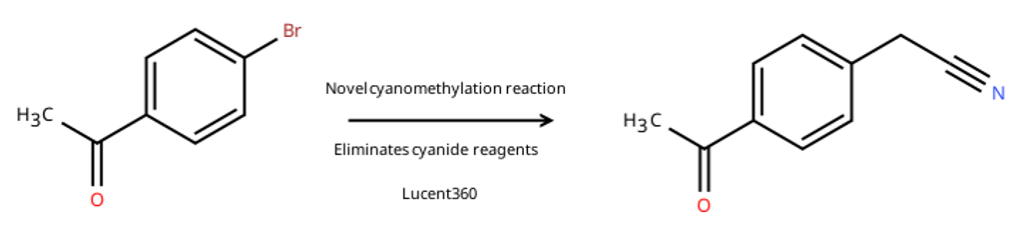
A serendipitous discovery
While attempting a different photochemical alkylation under standard Ir/Ni conditions, the GSK team observed an unexpected product: cyanomethylation, with the acetonitrile solvent itself coupling the aryl bromide. That observation became the starting point for a brand-new method.
What followed was an extensive HTE and Design-of-Experiments campaign — optimizing photocatalyst, nickel source, ligand, base, and stoichiometries — that lowered iridium and nickel loadings without sacrificing yield.
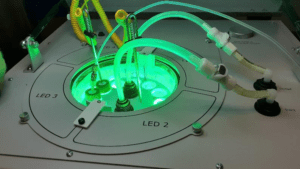
The Lucent360™ setup
The optimized conditions were applied to a substrate scope of medicinally relevant aryl bromides using the Lucent360™ in screening mode:
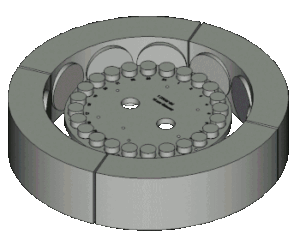
- 24 × 4 mL vial holder
- 5 independent light modules at 450 nm
- Reaction temperature held at 40 °C via thermostatic bath
- 22–88 hour irradiation
The reaction tolerated a wide range of functional groups — amides, alcohols, phenols, sulfonamides, ethers, and ortho-substituted systems — at modest but synthetically useful yields.
From discovery to drug intermediate
The team then applied their new method to a Senexin derivative, a known CDK8/19 inhibitor scaffold relevant to oncology research. The published route requires three steps — methylation, benzylic bromination, and SN2 displacement with cyanide — to deliver a key intermediate. Direct photochemical cyanomethylation accomplishes the same transformation in a single step, at a comparable 29% yield, and without a toxic cyanide reagent in sight.
The authors call their work “expedient,” and that word fits. Given the right tools, a serendipitous observation can become a tangible, scalable method in a single campaign.
Could the Lucent360™ accelerate your photochemistry?
If you are working on library-scale photoredox chemistry, HTE-driven optimization, or scale-up of photochemical reactions where wavelength, intensity, and temperature all need to be controlled — the Lucent360™ is the same instrument GSK used to develop this method.
Talk to us about your application — we are happy to discuss your substrates, throughput needs, and how the Lucent360™ would fit into your workflow.
More published examples using the Lucent360™:
Holm, A. R.; Wallick, R. F.; Vura-Weis, J.; Mirica, L. M. ACS Catalysis 2026, 16 (2), 1522–1532. “Illuminating the Role of Alcohol Substrate in Nickel Photoredox Catalysis via Ground State and Transient Absorption Spectroscopy.”
Lai, E. Y.; Ackermann, L.; Johansson, M. J. Chemical Science 2025, 16, 8478–8486. “A unified approach to meta-selective methylation, mono-, di- and trifluoromethylation of arenes.”