The Brasholz and Francke groups at the University of Rostock and Leibniz Institute for Catalysis report a tandem ketyl radical 3-exo-trig cyclization–lactonization that converts γ-branched δ-oxo acrylates into structurally complex tetracyclic γ-lactones under mild, metal-free conditions. The same transformation is accessible by two modern methods – photocatalytic PCET with 4CzIPN at 450 nm, or direct electroreduction – with high stereoselectivity and yields throughout.
Ketyl radicals are among synthetic chemistry’s most versatile reactive intermediates. Their hallmark reaction – addition to alkenes – enables C–C bond formation that builds molecular complexity rapidly and with high stereocontrol. The classical reagents for ketyl generation are samarium diiodide and alkali metals: effective but not without cost. SmI2 requires strict handling, generates stoichiometric metal waste, and its strongly reducing conditions limit compatibility with sensitive functional groups. A new paper from the Brasholz and Francke groups at the University of Rostock provides a practical alternative using visible-light photocatalysis and, in parallel, direct electroreduction – both enabled by proton-coupled electron transfer (PCET). 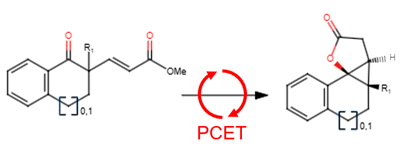 “PCET-Enabled Photocatalytic and Electrosynthetic Ketyl Radical Cyclopropanation: Stereoselective Synthesis of Tetrahydronaphthalene-Fused Cyclopropa[1,2-b]furanones”
L. Mishra, L. Lambert, O. Albrecht, A. Ovchenkova, R. Francke, M. Brasholz | Org. Lett. 2026, DOI: 10.1021/acs.orglett.6c02509
The substrate and the transformation
The authors targeted γ-branched α,β-unsaturated δ-oxo esters – substrates containing both an aromatic ketone (for ketyl radical generation) and a pendant acrylate (as the radical acceptor). Under reductive conditions, the ketone is converted to a ketyl radical that undergoes a 3-exo-trig cyclization onto the acrylate, forging a cyclopropane ring. The cyclopropanol intermediate that results spontaneously undergoes intramolecular lactonization to give a fully assembled tetracyclic γ-lactone containing a strained cyclopropa[1,2-b]furanone core. The entire cascade – ketyl radical formation, ring closure, and lactonization – occurs in a single pot from a readily accessible substrate.
Importantly, the products are tetrahydronaphthocyclopropa[1,2-b]furanones: densely functionalized tetracyclic scaffolds incorporating a cyclopropane ring fused to a γ-lactone within a tetrahydronaphthalene framework. These are structurally complex, three-dimensional products with multiple contiguous stereocenters – the kind of sp3-enriched polycyclic architecture that is difficult to access by other methods.
Photocatalytic method: 4CzIPN, amine/water buffer, acid-free PCET
The photocatalytic conditions use 4CzIPN (5 mol%) as an organic photosensitizer under 450 nm irradiation in MeCN/H2O with i-Pr2NEt as base. A critical practical point: unlike most photocatalytic PCET ketone reduction protocols, this system does not require a strong Brønsted or Lewis acid additive to activate the aromatic ketone. The amine/water buffer system does the job. i-Pr2NEt plays a dual role – it reductively quenches excited 4CzIPN (Stern–Volmer confirmed) and simultaneously activates the carbonyl via H-bonding as its ammonium cation form, enabling PCET to generate the neutral ketyl radical. The result is an exceptionally mild set of conditions that achieves SmI2-equivalent ketyl chemistry without any metal reductant or acid co-catalyst.
Standard photocatalytic conditions:
Photocatalyst: 4CzIPN (5 mol%)
Base/activator: i-Pr2NEt (10 equiv.) – dual role as electron donor and carbonyl activator
Solvent: MeCN/H2O (20:1, v/v)
Light source: EvoluChem™ 450 nm LED (18 W)
Photoreactor: EvoluChem™ PhotoRedOx Box (HepatoChem)
Temperature: 30 °C | Time: 20 h
Work-up: p-TsOH (1.2 equiv.), CH2Cl2, RT, 1 h (ensures full lactonization of cyclopropanol)
Model yield: 89% (8a, single diastereomer after p-TsOH treatment)
The photocatalytic scope covers 15 substrates with diverse γ-substituents: primary alkyl (8a–8f, 55–89%), benzyl (8g–8l, 8n, 79–88%), allyl, and propargyl groups. An indeno-fused tetracycle (8o) was also prepared from an allylated indanone-derived substrate. In all cases, the tetracyclic γ-lactone was obtained with high diastereoselectivity – the cyclopropanol intermediates are produced as d.r. = 7:1 to 8:1, and the major diastereomer readily lactonizes to give the tetracyclic lactone as a single diastereomer. Gram-relevant scale-up was demonstrated for compound 8g at 1 mmol, giving 81% isolated yield in the EvoluChem PhotoRedOx Box.
Substrate scope highlights
| Substrate (R group) | Product | Yield (photo) | Notes |
|---|---|---|---|
| Methyl (3a) | 8a | 89% | Single diastereomer; model substrate |
| Propyl (3b) | 8b | 79% | |
| Propargyl (3c) | 8c | 66% | Terminal alkyne retained |
| Allyl (3d) | 8d | 55% | |
| Benzyl (3g) | 8g | 88% (81% at 1 mmol) | Scale-up in PhotoRedOx Box; also by electrosynthesis |
| 4-Cl-Benzyl (3h) | 8h | 86% | Chloro group intact |
| 4-I-Benzyl (3m) | 8g (dehalogenated) | — | Reductive dehalogenation of C–I under radical conditions |
| Indanone-derived (3o, allyl) | 8o | reported | Indeno[1′,2′:1,3]cyclopropa[1,2-b]furanone scaffold |
Electrosynthetic route: the same transformation, no photocatalyst
A key feature of this paper is the demonstration that the same cyclization is accessible electrosynthetically, entirely without photocatalyst or light. Using controlled potential electrolysis at −2.2 V, the aromatic ketone in substrate 3g is reduced directly at a glassy carbon cathode to generate ketyl radical anion 3g•−, which cyclizes to the tetracyclic lactone in good yield.
Electrosynthetic conditions (compound 3g):
Cell: Undivided; glassy carbon working and counter electrodes
Reference: Ag/AgNO3 | Electrolyte: Et4NBF4
Applied potential: −2.2 V | Charge: 2 F/mol
Additive: H2O (5 vol%) in MeCN
Time: 30–45 min | Atmosphere: inert
Result: 8g, 87% yield (+ p-TsOH work-up)
Also demonstrated: 8i (68%) and 8e (72%)
The electrochemical route is faster (30–45 min vs 20 h photocatalytically), requires no photocatalyst, and operates through a mechanistically distinct pathway: direct cathodic SET generates ketyl radical anion 3g•− rather than a neutral ketyl radical from PCET. The addition of H2O (5 vol%) proved beneficial for yield, paralleling the role of water in the photocatalytic system. The availability of both methods from a single substrate class gives synthetic groups flexibility: those equipped for electrochemistry can access the products in under an hour; those working photocatalytically can use 4CzIPN and visible light with a standard photoreactor.
Mechanism: PCET, dual role of amine, and key controls
The mechanistic assignment as PCET rather than energy transfer or direct SET was established by several experiments. Stern–Volmer quenching showed that excited 4CzIPN is strongly quenched by i-Pr2NEt but only minimally by substrate 3a, confirming a reductive quench cycle. The competence of [Ir(dtbpy)(ppy)2]PF6 (ET = 49 kcal/mol) as a working catalyst despite its triplet energy being far too low to achieve EnT to the acrylate rules out energy transfer as the primary activation pathway.
Deuterium labeling was decisive: using D2O in place of H2O gave 89% deuterium incorporation into product 8a, confirming that the proton delivered in the PCET step originates from water (via the ammonium/amine equilibrium). No labeling occurred when CD3CN was substituted without D2O, confirming that MeCN solvent is not the proton source.
The proposed mechanism: excited 4CzIPN is reductively quenched by i-Pr2NEt to give [4CzIPN]•−. Concurrently, i-Pr2NEt in equilibrium with its ammonium cation (from H2O) forms a H-bonding complex with the aromatic ketone, lowering the reduction potential and enabling PCET. [4CzIPN]•− delivers an electron to the activated ketone complex with proton transfer from ammonium, generating neutral ketyl radical 3-H•. This radical adopts a conformation placing the enoate syn to the carbinol substituent and undergoes 3-exo-trig cyclization to give a C1,C7b-cis-configured cyclopropane α-carboxyl radical. Further SET reduction and protonation give cyclopropanol 7, which lactonizes (spontaneously on silica, or with p-TsOH) to tetracyclic lactone 8.
The EvoluChem PhotoRedOx Box as the reaction platform
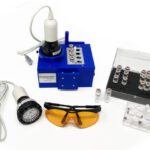
All photocatalytic reactions in this study were performed in the EvoluChem™ PhotoRedOx Box (HepatoChem) with the EvoluChem™ 450 nm LED (18 W). The SI instrumentation section states: “The vial was back-filled with argon and placed into the photoreactor (EvoluChem™ PhotoRedOx Box). The mixture was irradiated at 450 nm (18 W LED) at 30 °C.” A photograph and setup diagram (SI Figure S1) confirm the equipment used, citing hepatochem.com. The 1 mmol scale synthesis of compound 8g (81% isolated yield) was also performed in the same PhotoRedOx Box setup, demonstrating that the standard benchtop platform handles preparative-scale PCET cyclopropanation without modification.
Explore the EvoluChem PhotoRedOx Box
The photoreactor used for all reactions in this study, including 1 mmol scale synthesis. Equipped with the EvoluChem 450 nm LED (18 W).
Reference: L. Mishra, L. Lambert, O. Albrecht, A. Ovchenkova, R. Francke, M. Brasholz, Org. Lett. 2026. DOI: 10.1021/acs.orglett.6c02509
Equipment cited: EvoluChem™ PhotoRedOx Box (HepatoChem) with EvoluChem™ 450 nm LED (18 W). Source: SI Figure S1 and General Procedure.