
A new class of radical precursors from the Janssen-Müller group at Göttingen combines the synthetic accessibility of the century-old Biginelli reaction with redox properties that outperform the standard Hantzsch ester, allowing reactions that classical dihydropyridines cannot.
Hantzsch esters are one of the most useful reagents in modern photoredox chemistry. Easily made from aldehydes, bench-stable, and oxidizable under mild photochemical conditions, it has enabled a wide range of radical-mediated transformations including Giese additions, nickel-catalyzed cross-couplings, and reductive functionalization reactions. But it has a fixed redox profile, and the oxidation potentials available from the standard Hantzsch series — typically 1.0–1.2 V — set a ceiling on what the reagent can do.
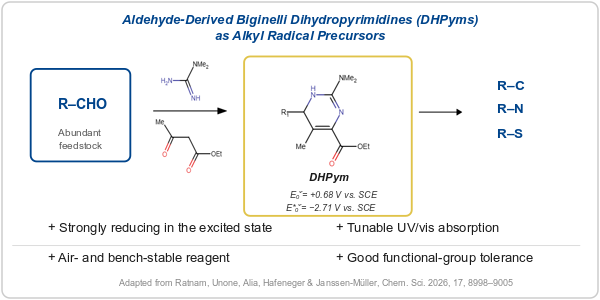
A new paper in Chemical Science from Shahilan Ratnam, Shreya Unone, Nabeel Alia, Enyu Denny Hafeneger, and Daniel Janssen-Müller at Georg-August-Universität Göttingen introduces a new family of heterocyclic radical precursors that addresses this ceiling directly. Their work, “Biginelli dihydropyrimidines: a tunable class of alkyl radical precursors,” shows that dihydropyrimidines (DHPyms) synthesized via the Biginelli reaction are not only competent radical precursors but are meaningfully more reducing than Hantzsch DHPs — and that their redox properties can be dialed in by changing substituents.
The Biginelli reaction as a modular entry point
The Biginelli reaction condenses an aldehyde, a β-ketoester, and a urea or guanidine derivative into a dihydropyrimidine in one step. The reaction has been known since 1891 and is operationally simple: stir at 75°C in DMSO or MeCN with sodium bicarbonate as base, and isolate the product by column chromatography. What the Janssen-Müller group recognized is that the nitrogen substituent at C2 of the pyrimidine ring — the component contributed by the urea or guanidine — has a direct and predictable effect on the oxidation potential of the resulting heterocycle.
Systematic variation of this substituent across five DHPym compounds revealed oxidation potentials spanning 0.68 to 1.05 V by cyclic voltammetry, with the dimethylamino-substituted compound (DHPym 1a) the most reducing. The excited state oxidation potential of 1a, calculated via the Rehm-Weller equation from absorption and emission data, is −2.71 V — substantially more negative than the corresponding value for the standard Hantzsch DHP. This means DHPym 1a is a significantly stronger photoreductant.
What the enhanced reducing power enables
The practical consequences show up immediately in competition experiments and substrate scope. In a head-to-head photocatalyst-free Giese addition using Ni(bpy)₃(BF₄)₂ as an electron mediator at 405 nm, DHPym 1a outperforms the Hantzsch ester. The enhanced conversion rate is consistent with the more negative excited-state potential driving faster single-electron transfer.
In Ni/photoredox dual catalysis cross-coupling at 450 nm with 4CzIPN, the DHPym substrate scope is broad:
- Aryl iodides and bromides with ethers, esters, nitriles, fluorine, chlorine, and CF₃ substituents
- Heterocyclic aryl halides: dioxanes, dioxolanes, indoles, and quinolines
- Good solvent tolerance across a wide polarity range (MeOH to PhMe), beneficial for substrates with limited solubility in acetonitrile
- Secondary and benzylic alkyl radicals derived from the DHPym reagent
The standout result is the coupling of unprotected bromoanilines. Free amines are a known problem for Ni/Hantzsch DHP cross-coupling protocols; the lower oxidation potential of the DHP reagent is not sufficient to drive the reaction cleanly in the presence of the amine. Switching to the more reducing DHPym 1a under Ni/Ir dual photocatalysis at 450 nm gives good yields with unprotected substrates. For medicinal chemists working on amine-containing targets, this is a significant practical improvement.
Beyond cross-coupling, the DHPym reagent was also deployed in reductive alkylation of nitrobenzene derivatives (thermal, copper-peroxide conditions) and in C–S bond formation with aryl disulfides under copper catalysis at 50°C — reactions where the higher reducing power of DHPym 1a provides genuine rate enhancement.
One-pot synthesis and practical stability
A key feature of the DHPym approach is that the reagents are bench-stable solids. Unlike some highly reactive radical precursors, DHPyms can be stored and handled without special precautions. The Biginelli synthesis is scalable: the lead compound 1a was prepared on 100 mmol scale in 61% yield.
The group also demonstrated a one-pot approach in which cyclohexanecarboxaldehyde is first converted to DHPym 1a via the Biginelli reaction in MeCN, followed directly by addition of the cross-coupling components in the same flask. A single degassing step between the two stages was the only procedural concession. This eliminates the column chromatography step normally required to isolate DHPyms after Biginelli reaction and substantially improves the practicality of the overall process.
Running it in the EvoluChem PhotoRedOx Box Duo
All photochemical reactions in this study were carried out in the EvoluChem PhotoRedOx Box Duo, using 390PF, 405PF, and 450PF EvoluChem LEDs (18 W) depending on the reaction. The Duo’s 16-vial parallel format, paired with interchangeable narrow-band LEDs, allowed the team to run substrate scope work, optimization, and mechanistic experiments under consistent irradiation conditions across all reactions.
— Prof. Daniel Janssen-Müller, Georg-August-Universität Göttingen
The availability of three LED wavelengths (390, 405, and 450 nm) within a single platform was directly relevant to this study: different reactions in the DHPym scope operated at different wavelengths, and the photocatalyst-free conditions at 390 nm required a distinct UV-A source.
Mechanism and radical clock validation
The radical nature of the alkyl transfer was confirmed by standard mechanistic probes. Addition of TEMPO or galvinoxyl to the Ni-catalyzed cross-coupling completely shut down the reaction, and the expected TEMPO adduct was characterized by GC-MS and HRMS. A radical clock experiment using a cyclopropylmethyl-substituted DHPym gave the ring-opened cross-coupling product cleanly, confirming that a free alkyl radical is formed under the reaction conditions.
Looking ahead
The Biginelli DHPym family extends the toolkit available for radical-mediated transformations in a direction that Hantzsch DHPs cannot easily follow: tunable reducing power, direct synthesis from aldehydes, tolerance for free amines, and a one-pot option from aldehyde to cross-coupled product. The modularity of the Biginelli reaction means that further refinement of DHPym redox properties — through substituent variation at C2, C4, or on the ester — is a straightforward synthetic exercise. The authors envision applications in late-stage functionalization of complex pharmaceuticals, natural product derivatives, and peptides, where the combination of mild conditions and broad functional group tolerance matters most.
Explore the EvoluChem PhotoRedOx Box Duo
16 vials in parallel. Three LED wavelengths. The platform behind this chemistry.
Reference: S. Ratnam, S. Unone, N. Alia, E. D. Hafeneger, D. Janssen-Müller, Chem. Sci. 2026, 17, 8998–9005. DOI: 10.1039/d6sc00376a
Equipment used: EvoluChem PhotoRedOx Box Duo with EvoluChem 390PF, 405PF, and 450PF LEDs (18 W).