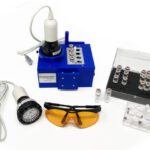
The Matyjaszewski group at Carnegie Mellon reports a UV-light-driven ATRP method that reaches ≥90% monomer conversion in under 10 minutes, at microliter scale, in open air – enabling high-throughput synthesis of polymer bioconjugates from DNA, RNA, proteins, and lipids without any deoxygenation step. All micropipette-tip experiments were run in the HepatoChem PhotoRedOx Box with EvoluChem™ UV LEDs (380 nm).
Polymer bioconjugates – the controlled conjugates of synthetic polymers with biomolecules such as proteins, DNA, RNA, and lipids – have become indispensable tools in modern drug development. PEGylation and related grafting strategies have extended the circulating half-lives and reduced the immunogenicity of dozens of approved biologics. The “grafting from” approach, in which a polymer chain is grown directly from a biomolecule macroinitiator via reversible deactivation radical polymerization (RDRP), offers better control over conjugate architecture than the classic “grafting to” method. But in practice, it remains difficult to execute at scale: conventional RDRP requires extended reaction times, rigorous deoxygenation, and reaction volumes large enough that working with expensive or scarce biomolecules becomes prohibitively costly. A new paper from the Matyjaszewski group at Carnegie Mellon University, published in Angewandte Chemie International Edition, changes this picture substantially.
“Oxygen-Tolerant Photo-Induced Miniaturized Accelerated Atom Transfer Radical Polymerization (OPTIMA-ATRP) for High-Throughput Synthesis of Polymer Bioconjugates”
A. M. Jazani, R. Wygoda, H. Murata, M. Madadi, G. Przesławski, K. Matyjaszewski | Angew. Chem. Int. Ed. 2026, e6617585
The barrier: conventional RDRP for bioconjugate synthesis
The fundamental tension in applying RDRP to biomolecules comes from conflicting demands. Controlled radical polymerization requires deoxygenated conditions, because dissolved oxygen terminates propagating radicals and generates reactive peroxide species that inhibit the reaction. Conventional degassing – freeze-pump-thaw cycles or extended inert gas sparging – is impractical at the microliter scales needed to conserve expensive biomolecules, often causes evaporation and protein denaturation, and is incompatible with parallel or high-throughput setups. Meanwhile, biomolecule macroinitiators such as therapeutic proteins and functional nucleic acids are expensive: microgram quantities are accessible, milligrams require significant investment, and grams are out of reach for many research groups. Reaction volumes of ≥2 mL, as required by standard RDRP protocols, make combinatorial synthesis effectively prohibitive.
The result is a technique with demonstrated potential – controlled polymer grafting from proteins, DNA, and lipids has been reported across many RDRP platforms – but a throughput ceiling that prevents the kind of systematic structure–property exploration that medicinal chemistry and AI-driven materials discovery now demand.
OPTIMA-ATRP: sodium pyruvate as the enabling reagent
The key innovation in the Carnegie Mellon paper is the use of sodium pyruvate (SP) as a multifunctional co-reagent activated by UV light. SP is an inexpensive, nontoxic, and water-soluble compound widely used as a hydrogen peroxide scavenger in mammalian cell culture – an unconventional starting point for a polymerization reagent, but one whose photochemistry turns out to be ideally suited to this problem.
Under UV irradiation (380–395 nm), SP undergoes photodecomposition to generate a sustained flux of radicals. These radicals serve three roles simultaneously: they react with dissolved oxygen, converting it to innocuous species and substantially deoxygenating the reaction medium within approximately two minutes; they reduce Cu(II) to Cu(I), continuously regenerating the active catalyst via a PICAR (photo-induced initiators for continuous activator regeneration) mechanism; and they sustain the radical concentration needed for fast propagation in the subsequent ATRP cycle. Because SP generates radicals gradually under light rather than in a single burst, it provides a self-regulating feed of activator that avoids the loss of control associated with high instantaneous radical concentrations.
The practical outcome is a system in which UV light simultaneously handles oxygen removal and catalyst regeneration. No prior deoxygenation step is required. The reaction begins immediately upon light exposure and proceeds rapidly under open-to-air conditions, with no sensitivity to the ambient environment beyond the need for irradiation.
Speed, control, and reproducibility
The combination of rapid O2 scavenging and continuous Cu(I) regeneration produces unusually fast polymerization kinetics. For the model hydrophilic methacrylate monomer OEOMA500, the apparent propagation rate constant was measured at kpapp = 34.2 × 10⁻² min−1; for the acrylate OEOA480, kpapp = 38.9 × 10⁻² min−1. Both monomers reached ≥90% conversion within 6 minutes, with narrow and monomodal molecular weight distributions (dispersity Ð = 1.11–1.25) and good agreement between absolute and theoretical molecular weights. A log-linear relationship between ln([M]0/[M]) and time confirmed constant radical concentration throughout, consistent with controlled polymerization rather than runaway radical chain growth.
The method is highly reproducible across independent runs. Three separate polymerizations at 5 minutes gave a mean conversion of 84.3% with a coefficient of variation of 1.37% and essentially superimposable GPC traces; three runs at 10 minutes gave 96.3% mean conversion with a CV of 0.60%.
Standard conditions (model system): [OEOMA500]0/[HOBiB]0/[CuBr2]0/[TPMA]0/[SP]0 = 100/1/0.2/0.6/65 in H2O with DMSO (10% v/v) and PBS (10% v/v). Open to air, no prior degassing.
Light source: EvoluChem™ UV LEDs (380 nm, 28.5 mW/cm²)
Photoreactor: HepatoChem PhotoRedOx Box (with active cooling)
Scale: 50 μL in 200 μL micropipette tips
Time to ≥90% conversion: ≤10 min
OPTIMA-ATRP tolerates a wide range of reaction volumes. The method has been demonstrated from 2.5 μL microdroplets on a glass plate exposed to ambient air through 10 μL and 100 μL in micropipette tips to standard 4.4 mL vials – with comparable conversion and dispersity across this 1,700-fold range. Operation at ultra-small scales in standard laboratory micropipette tips eliminates specialized reactor equipment, reduces material costs, and enables facile transfer directly from the reaction vessel to NMR tubes or SEC columns for characterization without an intermediate purification step.
Monomer scope: 18 hydrophilic monomers
The generality of OPTIMA-ATRP across different monomer classes was demonstrated for 18 hydrophilic methacrylates and acrylates covering a broad range of charge states and functional groups: neutral monomers (OEOMA500, OEOMA950, HEMA, glycerol monomethacrylate), positively charged monomers (QAMA), zwitterionic monomers (CBMA, PHCMA), and acrylate-based neutral and zwitterionic variants (MSEA, ADPS). All polymerizations reached high conversion (>60%) under the same general conditions, with monomodal GPC traces and moderate dispersities (Ð = 1.10–1.49). The broad compatibility with monomers bearing neutral, cationic, and zwitterionic groups – each of which confers distinct surface properties to the resulting bioconjugate – is practically significant for researchers targeting specific pharmacokinetic profiles in their protein–polymer hybrids.
Six classes of polymer bioconjugates in micropipette tips
The most consequential demonstration of OPTIMA-ATRP in the paper is the controlled grafting of synthetic polymers from six distinct biomolecule classes, all in 50 μL micropipette tips using the same light source and photoreactor. After covalently attaching an ATRP initiator to reactive –OH or –NH2 groups on the biomolecule, surface-initiated ATRP of OEOMA500 was carried out under UV irradiation for 2–10 minutes:
| Biomolecule class | Substrate | Mn,abs | Ð | Time |
|---|---|---|---|---|
| Nucleic acid | Single-strand DNA (5′-functionalized) | 31,600 | 1.10 | 10 min |
| Protein | Chymotrypsin (7 ATRP initiator sites) | 96,400 | 1.41 | 5 min |
| RNA | Biomass RNA (from yeast) | 149,200 | 1.18 | 10 min |
| Vitamin | Biotin (vitamin B7) | 28,900 | 1.13 | 2 min |
| Lipid | Cholesterol (THF/H2O solvent) | 20,400 | 1.33 | 10 min |
| Peptide | Peptide macromonomer (“grafting through”) | 53,500 | 1.19 | 5 min |
All bioconjugates were characterized directly – without prior purification – by 1H-NMR and SEC-MALS. The short UV exposure time (2–10 min) had minimal impact on biomolecule integrity. For chymotrypsin, circular dichroism confirmed negligible structural perturbation from UV irradiation, and enzymatic activity was retained at 90% under full polymerization conditions (including Cu catalyst, TPMA, and SP). The fast polymerization is not just a matter of convenience: reducing the time a sensitive biomolecule is exposed to UV light, exogenous metals, and reactive monomers directly improves the quality and activity of the final bioconjugate.
High-throughput parallel synthesis
OPTIMA-ATRP lends itself directly to parallel synthesis. Using a multichannel micropipette format in the PhotoRedOx Box, the authors synthesized 12 protein–polymer hybrids (chymotrypsin grafted with four different monomers at three target degrees of polymerization) within a total reaction time of 10 minutes. The coefficient of variation in conversion across all channels was 1.4%, and GPC traces from parallel channels were essentially superimposable. Downstream enzymatic activity assays on all 12 hybrids showed that OEOMA300 and CBMA grafts retained full chymotrypsin activity up to DPtarget = 132, demonstrating that the grafting process itself does not compromise protein function at moderate molecular weights.
Separately, in a 96-well plate format (395 nm LED array), 56 polymerizations were completed in a single 5-minute experiment – 7 monomers across 4 proteins (chymotrypsin, trypsin, glucose oxidase, and BSA) at two target degrees of polymerization – generating a complete dataset of protein–polymer hybrids in one pass. The authors explicitly position this capacity as enabling the large datasets needed to train AI and machine learning models for materials discovery.
The HepatoChem PhotoRedOx Box as the reaction platform
Every polymerization conducted in micropipette tips throughout this study – from the initial optimization of SP and catalyst ratios through the full 18-monomer scope and all six classes of polymer bioconjugate synthesis – was performed in the HepatoChem PhotoRedOx Box equipped with EvoluChem™ UV LEDs (380 nm, 28.5 mW/cm²). The SI instrumentation section states explicitly: “All polymerizations were performed in a photo-reactor (PhotoRedOx Box, HepatoChem, USA) with cooling fan using EvoluChem™ UV LEDs (380 nm, 28.5 mW/cm²).”
The active cooling provided by the PhotoRedOx Box is a practically relevant feature for this chemistry. Fast ATRP is exothermic at high conversions, and heat accumulation in 50 μL micropipette tips – which have poor thermal mass – can accelerate evaporation and compromise temperature-sensitive biomolecule macroinitiators. The authors also evaluated the Kessil® LED (370 nm, 25 mW/cm²) as an alternative light source; kinetics under the two sources were comparable (SI Figure S14), confirming that the photoinitiation step is not critically sensitive to small differences in wavelength or irradiance within this near-UV range. The EvoluChem LED was selected as the primary light source throughout the study.
For groups looking to implement OPTIMA-ATRP for polymer bioconjugate synthesis – whether optimizing conditions on a new substrate, expanding a monomer library, or preparing HTP datasets for machine learning – the PhotoRedOx Box with the EvoluChem 380 nm UV LED provides the complete, validated platform used in this work.
Explore the HepatoChem PhotoRedOx Box and EvoluChem UV LEDs
The platform used throughout this study. Active cooling for biomolecule-compatible photopolymerization. EvoluChem UV LEDs from 365 nm to 395 nm.
Reference: A. M. Jazani, R. Wygoda, H. Murata, M. Madadi, G. Przesławski, K. Matyjaszewski, Angew. Chem. Int. Ed. 2026, e6617585. DOI: 10.1002/anie.6617585
Equipment cited: HepatoChem PhotoRedOx Box with EvoluChem™ UV LEDs (380 nm, 28.5 mW/cm²). Source: SI Instrumentation section.