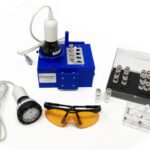
Shashank Shrotriya and Akkattu T. Biju at the Indian Institute of Science, Bangalore report a photochemical Alder-ene reaction between bicyclo[1.1.0]butanes (BCBs) and transient cyclohexynes that proceeds without a photocatalyst, without fluoride, and at ambient temperature. The reaction assembles skipped dienes bearing an all-carbon quaternary center in a single step and was performed in the EvoluChem™ PhotoRedOx Box throughout.
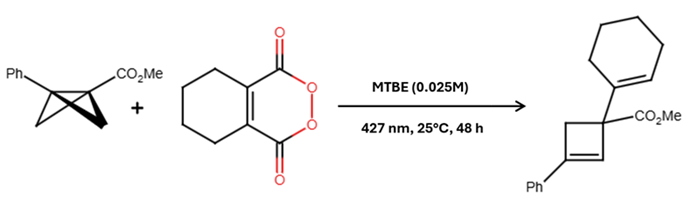
S. Shrotriya, A. T. Biju | Nature Communications 2026, 17, 10547 | DOI: 10.1038/s41467-026-77468-2
Exploiting Dual Strain Release with BCBs and Cyclohexynes
Bicyclo[1.1.0]butanes (BCBs) have become central building blocks in modern synthetic chemistry, prized for their high ring strain (66.3 kcal/mol) and the structural diversity accessible through release of that strain. BCBs participate in a broad array of annulation, cycloaddition, and ene-type reactions. Despite this versatility, one reactive partner had remained largely unexplored: cyclohexynes.
Cyclohexynes are strained alkynes that sit in an intermediate strain category – more reactive than unstrained linear alkynes, but less extreme than arynes. This intermediate reactivity makes them compelling partners for a dual strain-release manifold, but their use has been hampered by two practical issues: generation requires stoichiometric fluoride or strong base, and the resulting intermediates decompose rapidly before productive trapping can occur.
The Biju group’s solution was photochemical. Using a peroxide-based cyclohexyne precursor developed by Shi and co-workers, they found that irradiation at 427 nm generates cyclohexyne slowly enough to suppress competing decomposition pathways, while the high dilution conditions (0.025 M in MTBE) ensure that the BCB acts as an efficient trap. The result: a catalyst-free, fluoride-free, ambient-temperature Alder-ene reaction that assembles skipped dienes bearing an all-carbon quaternary center with broad functional group tolerance.
Standard Conditions
Optimized Reaction Conditions
| BCB substrate | 1 (0.10 mmol, 1.0 equiv) |
| Cyclohexyne precursor | Peroxide 2 (0.30 mmol, 3.0 equiv) |
| Additive | 4 Å molecular sieves (25 mg) |
| Solvent | MTBE, 0.025 M, nitrogen atmosphere |
| Temperature | 25 °C |
| Light source | 427 nm blue LED |
| Reaction time | 48 h |
| Photoreactor | EvoluChem™ PhotoRedOx Box (HepatoChem) |
Several features of these conditions are noteworthy. MTBE was optimal among all solvents screened – polar solvents (MeCN, acetone, THF) gave substantially lower yields (21–41%). The low concentration (0.025 M) is critical: dilution suppresses bimolecular decomposition of cyclohexyne while favoring productive capture by the BCB. The wavelength was also finely optimized – 427 nm outperformed 390 nm, 440 nm, 365 nm, and 254 nm, suggesting a specific match between the absorption of the photochemical peroxide precursor and the irradiation wavelength. Elevated temperature (50 °C) was detrimental, confirming that the photochemical pathway is distinct from thermal reactivity.
Mechanism: Concerted Alder-ene, Not Radical
The reaction mechanism was investigated through a series of controls and isotopic labeling experiments:
Light requirement: No product formed in the absence of light, even at 50 °C, ruling out thermally driven pathways.
Stepwise vs. concerted: Isolated cyclobutene 7a (the product of BCB isomerization) did not react under the standard conditions with the cyclohexyne precursor, excluding a stepwise pathway via cyclobutene.
Radical quenching: TEMPO completely inhibited product formation. BHT significantly suppressed yield (33% with BHT vs. 77% without). Notably, HRMS confirmed TEMPO reacted with in situ-generated cyclohexyne directly, suggesting radical character arises from the cyclohexyne itself under irradiation rather than from a chain process.
D-labeling: Using d4-BCB 1a′ (92% D incorporation), the product 3a′ was obtained with 92% deuterium incorporation at the cyclohexene position, with no H/D exchange observed even in the presence of 2.0 equiv of D2O or H2O. This is consistent with direct deuterium transfer in a concerted Alder-ene process.
Light on/off: Product formation proceeded during irradiation periods and ceased during dark intervals, confirming continuous photochemical activation is required.
Strain selectivity: When BCB was exposed simultaneously to in situ-generated cyclohexyne and the unstrained electron-poor alkyne DMAD, only the cyclohexyne-derived product 3a was observed (62% yield; no DMAD product 9). Strain alone is the decisive factor.
Together, these data are consistent with a concerted Alder-ene mechanism involving direct deuterium transfer from BCB to cyclohexyne, proceeding through a photochemically generated cyclohexyne intermediate rather than a persistent radical chain.
Substrate Scope
With the optimized conditions, the Biju group demonstrated broad generality across both BCB and cyclohexyne partners. For BCBs bearing aryl substituents, electron-donating, electron-neutral, and halogen groups at para- and meta-positions were all tolerated, giving skipped dienes 3a–3k in 52–77% yield. Ortho-substituted BCBs (“3l, 54%”) and disubstituted aryl rings (“3m, 78%; 3n, 56%”) were also accommodated. Beyond aryl-substituted BCBs, naphthyl (3o, 68%), vinyl (3p, 65%), and a range of ester groups (phenyl, benzyl, isopropyl, tert-butyl, cyclohexyl – 3q–3u) were all productive. Amide and heterocyclic motifs (pyrazole amide 3z, Weinreb amide 3aa) were compatible at 49–51% yield.
On the cyclohexyne side, monosubstituted cyclohexyne precursors gave 3ab–3ae in 48–73% yield (as inseparable regioisomeric mixtures), while 3,3-dimethyl cyclohexyne afforded 3af/3af′ in 71% yield. Monosubstituted BCBs (1ac–1ae) were not reactive under these conditions.
| Substrate class | Products | Yield range |
|---|---|---|
| Para/meta-substituted aryl BCBs | 3a–3k | 52–77% |
| Ortho-substituted aryl BCB | 3l | 54% |
| Disubstituted aryl BCBs | 3m, 3n | 56–78% |
| Naphthyl, vinyl BCBs | 3o, 3p | 65–68% |
| Varied ester BCBs | 3q–3u | consistent efficiency |
| Amide/heterocyclic BCBs | 3z, 3aa | 49–51% |
| Monosubstituted cyclohexyne precursors | 3ab–3ae | 48–73% |
| 3,3-Dimethyl cyclohexyne | 3af/3af′ | 71% |
Extension to Benzynes
The photochemical approach was extended to benzyne generation using o-diazonium carboxylic acid 4a as a precursor, which undergoes photochemical extrusion to generate benzyne upon 365 nm irradiation. The EvoluChem PhotoRedOx Box equipped with the EvoluChem™ HCK1012-01-029 365 nm LED was used for these reactions. Irradiation of BCB 1a with 4a in MeCN at 365 nm for 12 h gave aryl cyclobutene 5a in 96% yield – a substantially higher yield than the cyclohexyne variant, reflecting the higher strain energy of benzyne. The scope included differentially substituted BCBs (5a–5e), a pyrazole-derived BCB (5f, 79%), and a gemfibrozil-derived BCB (5g, 81%), all with high efficiency under mild, fluoride-free conditions.
Skeletal Remodeling to Tetralines
The skipped diene products serve as versatile platforms for further synthesis. Treatment of 3a with catalytic elemental sulfur (0.30 equiv) in DMSO at 140 °C (open air) furnished tetraline 6a in 86% yield. This transition-metal-free oxidative skeletal remodeling proceeds via thermal 4π-electrocyclic ring-opening of the cyclobutene, followed by intramolecular cyclization and aromatization. DMSO acts as both solvent and auxiliary oxidant, with sulfur as the terminal oxidant.
The tetraline scope is excellent: substituted examples (“6b–6h, 88–97%”), naphthyl (6i, 89%), benzyl ester (6j, 96%), and gemfibrozil-derived skipped diene (6k, 85%) all furnished tetralines in high yields. A deuterium-labeled analogue afforded 6a′ with complete deuterium retention, confirming the atom-economical nature of the cascade.
Scale-up and Product Diversification
The standard ene reaction was scaled up successfully, affording 3a in 74% yield in the EvoluChem™ PhotoRedOx Box. The skipped diene product was subsequently diversified through six distinct chemical transformations: LiAlH4 reduction (alcohol 10a, 89%), Grignard addition (tertiary alcohol 11a, 62%), saponification (carboxylic acid 12a, 81% – X-ray structure confirmed), m-CPBA epoxidation (13a, 55%, d.r. 2.2:1), exhaustive hydrogenation (saturated cyclobutane 14a, 78%), and ozonolysis with decarboxylation (15a, 70%). These transformations highlight the skipped diene as a convergent synthetic intermediate.
Late-Stage Diversification of Bioactive Molecules
The practical value of the method is further illustrated by its application to biologically relevant substrates. BCB esters derived from geraniol, L-menthol, and gemfibrozil all participated in the Alder-ene reaction to give the corresponding skipped dienes 3w–3y (54–71% yield), demonstrating that the protocol tolerates the structural complexity of drug-derived frameworks. For the gemfibrozil-derived skipped diene, the tetraline remodeling cascade also proceeded successfully (6k, 85%).
The Equipment Used
All photochemical reactions were performed in the EvoluChem™ PhotoRedOx Box (HepatoChem). The SI states:
“All photochemical reactions, unless otherwise stated, were performed in Schlenk tubes under nitrogen atmosphere. The reactions were carried out in a commercial Hepatochem EvoluChem PhotoRedOx Box device and irradiated with blue LEDs (either Kessil PR 160L: λmax = 440 nm, Kessil PR 160L: λmax = 427 nm, Kessil PR 160L: λmax = 390 nm, HCK1012-01-029 LEDs: 18 W, λmax = 365 nm).”
Supplementary Figure 1 provides a photograph of the PhotoRedOx Box used in this work (hepatochem.com). The optimized BCB–cyclohexyne reactions were run at 427 nm; the benzyne variant used the EvoluChem™ HCK1012-01-029 365 nm LED (18 W) in the same PhotoRedOx Box.
The EvoluChem™ PhotoRedOx Box was used for all reactions in this study – from optimization through scale-up and late-stage diversification.
Read the Full Blog Post
View PhotoRedOx Box
View EvoluChem LEDs
Reference:
Shrotriya, S.; Biju, A. T. “Visible light-mediated Alder-ene reaction of bicyclobutanes with cyclohexynes to access skipped dienes and skeletal remodeling to tetralines.” Nat. Commun. 2026, 17, 10547. DOI: 10.1038/s41467-026-77468-2
Equipment citation (SI, p. S2 and Supplementary Figure 1):
“The reactions were carried out in a commercial Hepatochem EvoluChem PhotoRedOx Box device.” (hepatochem.com)