Copper Instead of Iridium: A Well-Defined Cu–NHC Photosensitizer for Energy Transfer
The groups of Steven P. Nolan and Catherine S. J. Cazin at Ghent University, with Mark E. Thompson at the University of Southern California, report the first copper carbene–metal–amido complex to work as a general triplet–triplet energy transfer photosensitizer. [Cu(IPr)(Cbz)] drives four distinct reaction classes at 1–2 mol% under near-UV light, and reaches substrates whose triplet energies place them beyond most iridium sensitizers. The photocatalytic work was carried out in EvoluChem™ PhotoRedOx Box and PhotoRedOx Duo reactors using EvoluChem™ 365 nm and 380 nm LEDs.
The paper
A Well-Defined Cu–NHC (NHC = N-Heterocyclic Carbene) Complex for Energy-Transfer Photocatalysis
Tommaso Ruggiero, Yi-Jyun Lien, Pierre Arnaut, Yuan Zhao, Nestor Bracho Pozsoni, Francis Bru, Mark E. Thompson, Catherine S. J. Cazin and Steven P. Nolan
Department of Chemistry and Center for Sustainable Chemistry, Ghent University, Belgium; Department of Chemistry and Mork Family Department of Chemical Engineering and Materials Science, University of Southern California
Chemistry – A European Journal 2026, issue 35. DOI: 10.1002/chem.71184
What was standing in the way
Energy transfer photocatalysis has been built on ruthenium and iridium for more than a decade, and for good reason: they absorb in the visible, cross efficiently to the triplet, hold long excited-state lifetimes, and reach high triplet energies. The limitation is where that reach stops. Most iridium sensitizers exhibit triplet energies below 64 kcal/mol, which restricts their capacity to excite high-energy substrates, and only recent synthetic development has pushed a few toward 73 kcal/mol.
Two further drawbacks follow them around. Their cationic nature often gives low solubility in common organic solvents, which constrains solvent choice and with it the sustainability of the process. And they are expensive, frequently requiring multi-step synthesis.
Gold carbene–metal–amido (CMA) complexes – a line of work developed substantially by this same group – answered the performance and sustainability questions convincingly, and have been demonstrated across numerous transformations. What they did not answer is the metal itself: gold remains relatively expensive and is not Earth-abundant. The demand for cost-effective catalysts points at first-row transition metals.
Copper is the natural candidate, cheap and tunable, and copper photoredox catalysis under blue LEDs is a well-populated field. Copper-mediated energy transfer photocatalysis is not. What exists has relied on two kinds of system: the ill-defined Cu(I)/Cu(II) + BINAP combination, and heteroleptic [Cu(NN)(PP)X] complexes, used for E/Z isomerisation of cinnamates and stilbene and for a handful of [2+2] cycloadditions. The question the authors set themselves is whether a well-defined, easily assembled copper complex can act as a photosensitizer across a broad range of energy transfer processes.
The complex, and the problem its photophysics creates
The candidate is [Cu(IPr)(Cbz)] (1), where IPr is 1,3-bis(2,6-diisopropylphenyl)imidazol-2-ylidene and Cbz is carbazolyl – a copper analogue of the gold CMA sensitizers, built on the same donor–acceptor logic.
In THF at room temperature, 1 absorbs in the UV near 365 nm with a molar extinction coefficient comparable to [Au(SIPr)(Cbz)]. Its emission decays monoexponentially with a lifetime of 13 ns, closely resembling carbazole itself, which identifies the emissive state as a singlet ligand-centred (1LC) state localised on the carbazolyl moiety. Cooling to 77 K in 2-MeTHF brings out a new emission feature at 400–550 nm with a long-lived monoexponential decay of 28 ms.
Here is the complication. No phosphorescence is observable at room temperature, which indicates that intersystem crossing is efficient but the triplet excited state decays nonradiatively – the 3LC is a dark state. A lifetime you cannot measure by emission has to be measured another way, so the authors turned to nanosecond transient absorption with a 355 nm pump. The nsTA data show significant spectral changes from 20 ns to 20 μs before returning to baseline, with a broad excited-state absorption from 400 to 750 nm. Fitting the decay at 580 nm to a single-exponential model gives a time constant of 6.9 μs.
That is a factor of roughly 45 shorter than the gold congeners: [Au(IPr)(Cbz)] and [Au(SIPr)(Cbz)] show lifetimes of 266 and 335 μs respectively. The question is therefore not how copper compares to gold in the abstract, but whether 6.9 μs is long enough relative to the timescale of diffusion, which is on the order of nanoseconds.
|
Stern–Volmer answers it Quenching studies in THF using varying concentrations of cinnamyl ether 2, monitoring the excited-state absorption of 1 at 580 nm, gave a linear Stern–Volmer plot and a quenching rate constant of 9.59 × 10⁸ M−1 s−1 – comparable to the gold congeners and close to the diffusion-controlled limit in THF. Quenching occurs efficiently through collisional encounters, so the excited state of 1 is sufficiently long-lived and reactive for bimolecular chemistry. The short lifetime is a real difference from gold; it is not a disqualifying one. |
Standard conditions
|
Substrate (0.05–0.2 mmol), 4 mL vial with stirring bar [Cu(IPr)(Cbz)] (1), 1–2 mol% Ethyl acetate or tetrahydrofuran (1 mL), degassed Olefin partner, 3 equiv., where intermolecular 365 nm near-UV, room temperature, 1–20 h Conversions and yields by 1H NMR against 1,3,5-trimethoxybenzene, averaged over two experiments |
Intramolecular [2+2] cycloadditions
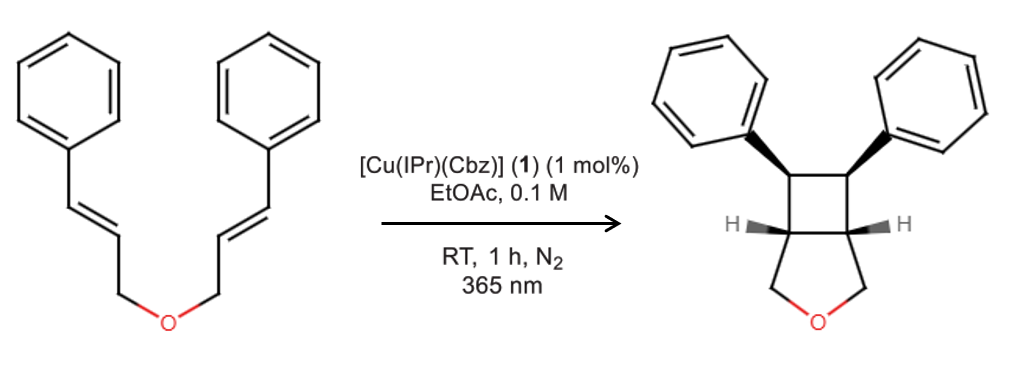
The model reaction is cinnamyl ether 2 closing to bicyclo[3.2.0]heptane 3. At 1 mol% loading in ethyl acetate under 365 nm, conversion was quantitative and 3 was obtained in 83% NMR yield after 1 h. Tetrahydrofuran (100% conversion, 81%) and diethyl carbonate (100%, 80%) were both compatible; acetonitrile was poorer (82%, 60%). Halving the catalyst loading to 0.5 mol% gave incomplete conversion at 91% and a 79% yield.
Two indole substrates followed. The C3-tethered indole 4 cyclised at 2 mol% in 1 h, with tetrahydrofuran giving full conversion and 96% yield; at 1 mol% conversion fell to 85%. The N-tethered indole 6 – previously handled by Fu using [Ir(dFCF3ppy)2(dtbbpy)]PF6 in trifluoroethanol – gave full conversion and 96% NMR yield of 7 in ethyl acetate at 2 mol% in 1 h. Lowering to 1 mol% reduced conversion to 75%.
Intermolecular [2+2], and the triplet energy argument
Coumarin 8 with vinyl-trimethylsilane 9 gave cycloadduct 10 in 81% NMR yield under optimized conditions in THF with no observed dimer formation, and 79% isolated as the combined yield of diastereomers. Dimerisation of coumarin is a known competing pathway, so its absence is a result in itself: at 16 h the reaction reached 96% conversion, 69% of 10 and 19% of the anti-head-to-head dimer 11, while reducing the loading to 0.5 mol% tipped the balance badly (75% conversion, 23% product, 50% dimer).
The more demanding substrate is 1-acetylindole (12). High triplet energies have always hindered the use of indoles in energy transfer, and the usual workaround is to substitute at C2 or C3 to lower the triplet energy enough for a state-of-the-art sensitizer to reach it. The triplet energy of 12 has been calculated at 67.2 kcal/mol, significantly higher than coumarin at 61.8. With 1 at 2 mol% in ethyl acetate for 5 h, cycloadduct 13 was isolated in 70% yield; switching to THF gave full conversion and 82%. No dimer formation was observed under any condition tested.
This is the result behind the paper’s central claim: 1 is the first copper-based photosensitizer competent in intermolecular [2+2] cycloadditions of substrates with triplet energies above 62 kcal/mol.
Hydrogen atom transfer via energy transfer
N-Aryl acrylamide 14 delivered the 3,4-dihydroquinolin-2-one 15 in 76% NMR yield at 2 mol% in THF over 16 h. Substituting ethyl acetate (45% conversion, 30%), shortening to 5 h (62%, 43%), or dropping to 1 mol% (77%, 50%) all cost conversion and yield.
The companion result is the more unusual one. EnT-driven β-lactam formation from N-benzyl acrylamides has been rarely reported. N-Benzyl acrylamide 16 in ethyl acetate reached full conversion after 16 h, giving β-lactam 17 in 75% NMR yield; THF gave the same yield, and shortening to 6 h dropped conversion to 70%.
E/Z isomerisation
As a final test of energy transfer activity, three benchmark olefins. Methyl cinnamate 18 reached a 43:57 Z/E mixture after 1 h in ethyl acetate at 1 mol%, a ratio unchanged by switching to THF, extending to 4 h, or doubling the loading. Stilbene 20 gave 63:37 Z/E, and cinnamyl alcohol 22 likewise 63:37, both at 1 mol% in 1 h.
The controls are clean throughout: in darkness the cinnamate gave 0:100, without catalyst 0:100, and with 10 mol% carbazole only 3:97. For cinnamyl alcohol the catalyst-free reaction gave 7:93 and no product formed in the absence of light.
The evidence that this is energy transfer
Three control experiments on the model [2+2] carry the mechanistic case. Performing the reaction in darkness gave no product. Running without catalyst gave 9% conversion. Adding 1 equiv. of isoprene, a well-known triplet quencher with a triplet energy of 60 kcal/mol, cut conversion to 25% and yield to 18% – consistent with its triplet quenching activity.
The fourth control is the one that justifies the molecular design. Carbazole alone at 10 mol% as sensitizer afforded only 11% conversion and 7% yield. The carbazolyl fragment is where the emissive state lives, but on its own it is nearly inactive, which underscores the necessity of the donor–acceptor architecture of 1 rather than of either component separately.
The reaction quantum yield, determined by ferrioxalate actinometry, is ΦR = 0.28. A value below unity is consistent with the proposed triplet–triplet energy transfer mechanism rather than a radical chain.
365 nm against 380 nm, across all four reaction classes
The authors included a 380 nm control in every reaction class they studied. It is worse in every one, and for a 15 nm move the differences are substantial.
| Reaction class | 365 nm | 380 nm |
|---|---|---|
| Intramolecular [2+2] → 3 | 100% conv., 83% | 60% conv., 48% |
| Coumarin [2+2] → 10 | 96% conv., 69% (+19% dimer) | 34% conv., 7% (+26% dimer) |
| HAT cyclisation → 15 | 76% | 52% conv., 32% |
| E/Z isomerisation of 18 | 43:57 Z/E | 24:76 Z/E |
The coumarin row is the most instructive, because what changes is not only how much product forms but which product does. At 365 nm the cycloadduct dominates and the dimer is a minor component; at 380 nm that relationship inverts. A sensitizer whose absorption sits near 365 nm behaves differently when you move off its band, and the consequence can be a change in selectivity rather than a simple loss of rate.
For anyone developing energy transfer chemistry, this is a useful argument for treating wavelength as a variable to screen rather than a property of whatever light source happens to be installed. Single-wavelength LEDs make that screen a swap of a few seconds, and keep everything else about the irradiation geometry constant while you do it.
Equipment
From the Supporting Information, General Information (p. S2):
|
“Photocatalytic experiments were performed in EvoluChem™ PhotoRedOx Box or EvoluChem™ PhotoRedOx Duo Box by HepatoChem. EvoluChem™ LED. 365PF (365 nm, 18 W, 9 mW/cm²), 365DX (365 nm, 30 W, 25 mW/cm²), 380PF (380 nm, 18 W, 8 mW/cm²) lamps were used as light sources. For all photocatalytic reactions at 365 nm, PhotoRedOx Duo setup with two lamps at 18 W and 30 W were used. For both setups the built-in fans were used for cooling. For the quantum yield of the reaction, EvoluChem™ PhotoRedOx Box with 365PF (365 nm, 18 W, 9 mW/cm²) was used.” “Position of the vials: for optimization of the reaction conditions, the first row (the one closer to the lamp) was used in PhotoRedOx Box for a fair comparison.” |
Three aspects of that setup are worth drawing out, because each corresponds to a decision a reader might face.
The Duo running two lamps at once. Every 365 nm reaction used the PhotoRedOx Duo with an 18 W PF lamp and a 30 W DX lamp together. That is the Duo used as a photon-delivery configuration rather than as double throughput – two sources on one reaction, at the same wavelength, from opposite sides. The single-lamp PhotoRedOx Box was reserved for the actinometry.
Vial position, fixed and declared. The authors held every optimization run in the first row, nearest the lamp, explicitly for a fair comparison. Distance from the source is a genuine variable inside any enclosure, and what a fixed-geometry reactor offers is not that the variable disappears but that you can pin it, repeat it, and write it down. That one sentence is what makes their optimization table internally comparable, and it is reproducible by anyone with the same reactor. It is a good model for how to report a photochemical screen.
Actinometry in the box. The reaction quantum yield was measured in the PhotoRedOx Box with a single 365PF lamp. Ferrioxalate actinometry put the photon flux of that setup at 3.43 × 10⁻⁷ mol/s, and the reaction quantum yield followed at ΦR = 0.28. A quantum yield is only meaningful against a known photon flux in a defined geometry, which is why measuring it in a standardised reactor – rather than under a lamp on a stand – is what makes the number portable to another lab.
The LEDs cited are catalogue parts: the PF series at 18 W and the higher-power DX series at 30 W, both at 365 nm, alongside the 380 nm PF lamp used for the wavelength comparison. We QC every LED for irradiance before shipping and can supply the measured spectra.
Why this matters
The headline is a metal substitution, but the more durable contribution is a demonstration that the carbene–metal–amido architecture transfers down the group. The donor–acceptor design that made the gold sensitizers effective survives the move to copper, even though the excited-state lifetime drops by a factor of 45 – because what the chemistry actually requires is efficient bimolecular quenching on the diffusion timescale, and 6.9 μs clears that bar comfortably.
For anyone whose substrate sits above the triplet energy ceiling of a standard iridium sensitizer, there is now a first-row alternative that is cheaper, better behaved in ordinary organic solvents, and competent across cycloadditions, hydrogen atom transfer and isomerisation alike. The authors note that expanding the scope of these reactions, and exploring further photochemical applications of 1 and its congeners, is ongoing in their laboratories.
|
The same wavelength, every run – and a different one when you want to compare Single-wavelength EvoluChem LEDs from 254 to 1000 nm, in a reactor that fixes the geometry so a comparison means something.
|
Reference
Tommaso Ruggiero, Yi-Jyun Lien, Pierre Arnaut, Yuan Zhao, Nestor Bracho Pozsoni, Francis Bru, Mark E. Thompson, Catherine S. J. Cazin and Steven P. Nolan. “A Well-Defined Cu–NHC (NHC = N-Heterocyclic Carbene) Complex for Energy-Transfer Photocatalysis.” Chemistry – A European Journal 2026, issue 35. DOI: 10.1002/chem.71184. The authors gratefully acknowledge support from The Research Foundation – Flanders (FWO) (G0A6823N and G0C5423N), thank Dr. Nikolaos Tzouras and Roman Larkovich for providing substrates, and thank Umicore AG for generous gifts of materials.
Equipment citation: Supporting Information, General Information (p. S2) – EvoluChem™ PhotoRedOx Box and PhotoRedOx Duo Box by HepatoChem, with EvoluChem™ 365PF, 365DX and 380PF LEDs.