Redox Gating: Making Allylic C–H Oxygenation Land on the Tertiary Position
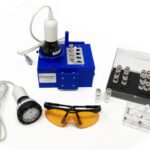
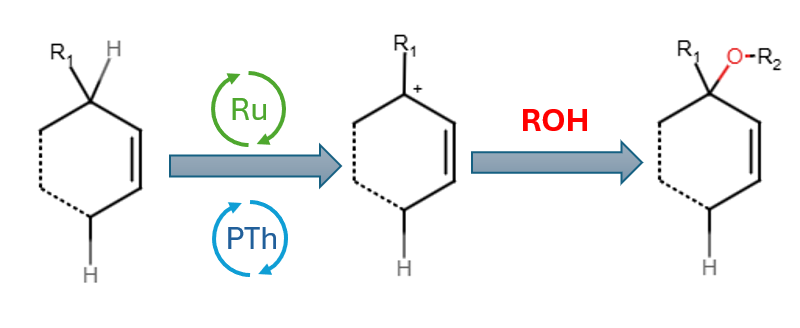
Vladimir Gevorgyan’s group at UT Dallas has published a photoredox method that oxygenates tertiary allylic and propargylic C–H bonds with alcohol or water nucleophiles, reported in the Journal of the American Chemical Society. Reaching the tertiary position at all required switching to oxygen-centred radicals, which abstract hindered tertiary C–H bonds where the bulky aryl radicals of earlier systems could not. Choosing between tertiary and secondary then had to be solved separately, and it is solved downstream of the abstraction: by an oxidation tuned to sit between the oxidation potentials of the two allylic radicals. Fifty-six of the sixty-seven photochemical products were prepared in an EvoluChem™ PhotoRedOx Box.
Why tertiary allylic positions are hard
Tertiary allylic alcohols and their derivatives are common in natural products and in pharmaceutically active compounds, and the established routes to them are indirect. Transition-metal-catalysed Tsuji–Trost allylic substitution offers excellent regio- and stereocontrol, but it needs a prefunctionalized allylic substrate carrying a leaving group, which often takes extra steps to install and constrains what you can make. The functionalized products are also predominantly limited to terminal alkene frameworks.
Direct C–H functionalization avoids the prefunctionalization problem but introduces a selectivity one. Classical π-allyl chemistry prefers the less hindered position, and classical Riley allylic oxidation does the same, typically giving primary or secondary allylic alcohols or aldehydes. Neither gets you cleanly to the tertiary site, which is precisely the one that builds a quaternary carbon centre.
In the photoredox approaches established before this work, the obstacle is specifically steric. The hydrogen atom abstraction is performed by bulky aryl radicals, and they cannot reach a tertiary allylic position. As the authors describe it, “due to steric effect exerted by bulky aryl radicals, HAT is limited to primary and secondary allylic C−H bonds, thus predominantly leading to oxygenation at these less sterically hindered sites. Consequently, direct tertiary allylic C−H oxygenation remains a significant challenge.” For an internal alkene, abstraction at a secondary allylic position is far more prevalent than at a tertiary one, and depending on the substrate and the geometry of the approaching radical the tertiary position may not be reachable at all.
Those systems carry a second restriction that matters for what you can make with them: simple aliphatic alcohols are unreactive, because in the presence of base they are consumed by competitive nucleophilic aromatic substitution (SNAr) with the aryl halides. Overcoming both limitations is what opens up the broader chemical space.
The paper
Redox-Gated Tertiary Allylic C−H Oxygenation via Photocatalytic Radical-Polar Crossover
Tong Zhang, Sachin Giri, Gleb Kubrin and Vladimir Gevorgyan
Department of Chemistry and Biochemistry, The University of Texas at Dallas
J. Am. Chem. Soc. 2026, 148, 28010–28018. DOI: 10.1021/jacs.6c01586
Two problems, solved in two different places
The first move is to change the abstracting species. The authors turned to oxygen-centred radicals (•OR) as the HAT reagents, chosen, in their words, “because of their well-established ability to abstract sterically hindered tertiary C−H bonds and their convenient generation from redox-active esters (RAEs).” This is the conceptual extension at the heart of the paper: a class of radical already trusted for hindered tertiary C–H bonds generally is brought to bear on the allylic tertiary case, where aryl radicals could not go.
Solving the steric problem immediately exposes a second one. Once the tertiary allylic C–H bond is reachable, the secondary one still is too, and the bond dissociation energies are comparable – so there is no thermodynamic handle to abstract one in preference to the other. The authors are explicit that this route is closed: “given comparable bond dissociation energies (BDE), selective HAT of sterically more hindered tertiary allylic C−H bonds in the presence of secondary allylic C−H bond appears unrealistic.”
So the selectivity cannot live in the abstraction step. It is placed one step downstream instead, at the electron transfer that follows – which is where the redox gate comes in.
The redox gate
The design rests on a reported difference in oxidation potential between allylic radicals: approximately 0.9 V vs SCE for secondary and 0.7 V vs SCE for tertiary. An oxidant whose redox window sits below 0.9 V will therefore take the tertiary allylic radical through to a carbocation while leaving the secondary radical untouched.
That single choice does all the regiochemical work. The hydrogen atom transfer is free to stay unselective, abstracting from both positions, because only one of the two resulting radicals is competent to continue. The tertiary carbocation is then trapped by an oxygen nucleophile, and the unreacted secondary allylic radical can be recycled back to the substrate by an appropriate hydrogen atom donor.
Mechanism
The optimized system is a dual catalytic one: Ru(bpy)3(PF6)2 at 1 mol% together with 10-phenylphenothiazine (PTh) at 10 mol%, plus the redox-active phthalimide reagent HAT1 at 4 equivalents. Based on the authors’ mechanistic studies, the proposed cycle runs as follows.
Photoexcited [RuII]* undergoes reductive quenching by PTh to generate [RuI], a step consistent with fluorescence quenching experiments. [RuI] then reduces HAT1, triggering fragmentation to 1,3-dioxoisoindolin-2-ide and a tert-butoxy radical, whose formation was confirmed by trapping experiments. The tert-butoxy radical abstracts a hydrogen atom from the allylic C–H bond. The resulting tertiary allylic radical is oxidized by the PTh radical cation to the carbocation, regenerating PTh in the process. Nucleophilic attack by the alcohol gives an alkyloxonium intermediate, which is deprotonated by the phthalimide anion to deliver the product, with isoindoline-1,3-dione as the major byproduct.
Control experiments confirm that the dual system is essential. Omitting [Ru], PTh or light individually each dropped the yield to <5%. Using PTh or 12-phenyl-12H-benzo[b]phenothiazine (PTh-2) alone as the photocatalyst gave only trace product. Substituting tetrathiafulvalene for PTh as the oxidant gave 20% against 83% for the standard conditions.
The fate of the secondary radical
A gate that stops the secondary radical does not, by itself, dispose of it. GCMS analysis showed that the stranded secondary allylic radical undergoes unproductive dimerization, consuming substrate.
Adding 2,4,6-triisopropylbenzenethiol (TRIPSH) at 0.5 equivalents promotes back-HAT, returning the secondary radical to the starting alkene. Dimer formation fell and unreacted starting material rose accordingly. The involvement of back-HAT was further supported by deuterium labelling using TRIPS-D prepared at 97% deuterium incorporation. The authors also note that hydrogen atom transfer from TRIPSH appears to outpace alkene isomerization, which is why no regioisomeric products derived from the starting material were detected under either condition.
The additive is not universally beneficial. For substrates bearing electron-withdrawing groups, polarity mismatch already disfavours hydrogen abstraction at the secondary allylic position and oxidation is already selective for the tertiary site, so TRIPSH provided little benefit and in some cases slightly reduced yields.
Standard conditions
|
Alkene or alkyne (0.1 mmol, 1.0 equiv.) Alcohol (0.3 mmol, 3 equiv.); omitted for intramolecular reactions HAT1 (0.4 mmol, 4 equiv.) PTh (0.01 mmol, 10 mol%) Ru(bpy)3(PF6)2 (0.001 mmol, 1 mol%) Dry benzonitrile (0.2 mL, 0.5 M) 1.5 mL vial, charged in an N2-filled glovebox, sealed with a septum screw cap 450 nm irradiation, 24 h, ca. 35 °C |
A second general procedure (GP2) adds TRIPSH at 0.5 equivalents, then recharges the reaction after 24 h with a further 2 equivalents of HAT1 and 0.5 equivalents of TRIPSH before running for another 24 h.
Solvent choice is unusually consequential. Benzonitrile delivered 83%; acetonitrile and tert-butyl nitrile gave 65% and 64%; and dichloromethane, DMSO, benzene, chlorobenzene and trifluoroethanol all fell to 0–20%. Reducing HAT1 from 4 to 3 equivalents dropped the yield to 45%, and reducing the alcohol from 3 to 1.5 equivalents gave 49%.
Scope: alcohol nucleophiles
Both primary and secondary alcohols are competent. Simple aliphatic alcohols performed well – 2-phenylethan-1-ol (1, 77%), methanol (2, 45%), n-hexanol (3, 75%) and cyclohexanol (4, 68%). Alcohols carrying strained carbocyclic units were tolerated, including cyclopropane (5, 72%) and bicyclo[1.1.1]pentane (6, 70%).
Fluorinated alcohols gave satisfactory yields (7, 44%; 8, 48%), the lower values plausibly reflecting their diminished nucleophilicity. A trimethylsilyl substituent survived cleanly (9, 78%), leaving a synthetic handle in place. Alcohols containing a terminal allyl group were competent but lower yielding (10, 29%; 11, 37%).
Heterocyclic frameworks including tetrahydropyran and piperidine were well tolerated (12, 67%; 13, 68%; 14, 45%), as was a carbamate moiety (15, 67%). With 1,2-hexanediol, which offers both a primary and a secondary alcohol, the reaction proceeded at the primary site exclusively (16, 72%).
Beyond alcohols: water, amines, fluoride
Water is a capable nucleophile, delivering the tertiary allylic alcohol directly (19, 52%) – the product class that classical Riley oxidation does not provide, since it proceeds at the least hindered position to give primary or secondary allylic alcohols or aldehydes (20, 21). This complementarity is one of the clearest arguments for the method.
A Boc-protected amine was also competent, though steric congestion drove it exclusively to the less hindered benzylic site, giving the secondary allylic amination product (17, 48%). Tertiary allylic fluorination succeeded using silver fluoride (18, 56% by 19F NMR); the product is too unstable to isolate.
Pharmaceutically relevant and natural product alcohols served as nucleophiles as well: (±)-menthol (23, 50%), L-(−)-borneol (24, 45%) and an α-D-galactopyranose derivative (25, 66%).
Scope: alkenes
Para-substituted styrenes bearing electron-donating groups such as tert-butyl (26, 54%) and methyl (27, 76%) reacted well, as did those bearing electron-withdrawing halogens and trifluoromethyl (28, 74%; 29, 62%; 30, 60%). Halide survival matters practically: nothing in the mechanism is a cross-coupling, so an aryl bromide remains available for a subsequent step.
The reaction tolerated ortho (31, 55%; 32, 64%), meta (33, 47%; 34, 58%) and meta/para-disubstituted (35, 50%; 36, 76%) styrene derivatives regardless of electronics. A pyridine-containing substrate reacted at 52% (37), and cycloalkyl groups of four-, five- and six-membered ring sizes all performed (39, 58%; 40, 55%; 41, 68%).
The instructive failure is the cyclopropyl substrate (38), which did not react. Rather than attribute this to the stronger C–H bond (89.3 kcal/mol against 75.7–79.2 for the less strained analogues), the authors tested a cyclopropylidene derivative containing a secondary C–H bond that is known to be readily cleaved under these conditions. That substrate also remained intact, indicating that the elusive cyclopropylidene cation intermediate is simply not formed. The limitation is cationic, not homolytic.
Notably, 1,1-disubstituted alkenes possessing secondary C–H sites also give tertiary allylic oxygenated products, because the allylic radical formed is oxidized to an allyl cation whose trapping is governed by sterics and conjugation. This provides direct access to tertiary allylic ethers from secondary alkenes. Regiochemical outcomes across a dedicated series (45–49) map onto that reasoning: a symmetrical cation with two equivalent tertiary positions gives a single product (45, 46%), unsymmetrical cations are trapped at both tertiary and secondary positions, and where a bulky tert-butyl group shields the tertiary site or conjugation stabilizes the alternative, trapping occurs exclusively at the secondary position (48, 29%; 49, 44%).
Propargylic substrates
Tertiary propargylic substrates underwent alkoxylation at the propargylic site exclusively, with no traces of allene products detected (58, 54%; 59, 45%; 60, 40%; 61, 47%; 62, 42%; 63, 54%; 64, 47%). Given how readily propargylic radical chemistry isomerizes to allenes, the complete absence of allene products is one of the more striking results in the paper. Primary and secondary alcohols and water all served as nucleophiles here, affording tertiary propargylic ethers (66, 44%; 67, 42%; 68, 35%).
Intramolecular oxygenation
Run without an external alcohol, substrates carrying a pendant hydroxyl close onto the allylic cation to give cyclic ethers (69, 25%; 70, 47%; 71, 22%). This mode gives access to heterocycles bearing quaternary carbon centres and rounds out the method: the same catalytic system serves both intermolecular and intramolecular oxygenation.
|
Scale The scope was run at 0.1 mmol throughout, with one example in Scheme 2 carried out on 1 mmol scale (Scheme 2, footnote b) – a tenfold increase over the standard scale. One further example was run at 0.3 mmol (22, 31%). Chemists planning larger runs should note that the standard procedure uses a 1.5 mL vial at 0.5 M, so volume, not light, is the first constraint to address. |
Equipment
From the Supporting Information general procedure (GP1, p. 28):
|
“… the mixture was stirred for 24 h under irradiation of [a] 450 nm [lamp] with the EvoluChem PhotoRedOx Box (PR-A) at ca. 35 °C (no fan).” |
The Supporting Information’s General Information section records that the EvoluChem™ PhotoRedOx Box was purchased from HepatoChem Inc.
Unusually, the SI identifies the reactor used for every individual compound, which makes the equipment record in this paper more precise than most. Fifty-six of the sixty-seven photochemical products were prepared in the PhotoRedOx Box, spanning the alcohol nucleophile scope, the alkene scope, the regiochemistry series, the propargylic series, the intramolecular cyclizations and the fluorination experiment.
Two practical details stand out. First, the reactions were run in 1.5 mL vials at 0.1 mmol and 0.5 M – a 0.2 mL reaction volume. At that scale, across a scope of this size and over 24 h irradiations, the vial’s position and orientation relative to the light source is not a detail but a variable, and a fixed-geometry enclosure removes it from the experiment. Second, the box was run deliberately with the fan off, holding roughly 35 °C rather than ambient. That is a reproducible, recordable condition that another group can set up and match.
This is what the PhotoRedOx Box is for. It is not a device for winning a kinetic race against a bare lamp pointed at a single vial; it is a device for making the sixtieth substrate in a scope behave the way the first one did, and for making a procedure transferable between people and between labs. A 67-compound scope run over months is exactly the setting where that matters.
Why this matters
The broader idea here is portable. Whenever two radical intermediates in a mixture differ meaningfully in oxidation potential, an oxidant chosen to sit between them converts a selectivity problem at the bond-breaking step into a thermodynamic sorting problem at the electron-transfer step. Hydrogen atom transfer does not have to be selective if the gate downstream is. That reframing is likely to find applications well beyond allylic oxygenation, and it is the part of this work worth carrying into your own planning.
|
Standardized photochemistry, from the first screen to the sixtieth substrate Fixed irradiation geometry, defined vial positions, and conditions you can write down and hand to someone else.
|
Reference
Tong Zhang, Sachin Giri, Gleb Kubrin and Vladimir Gevorgyan. “Redox-Gated Tertiary Allylic C−H Oxygenation via Photocatalytic Radical-Polar Crossover.” Journal of the American Chemical Society 2026, 148, 28010–28018. DOI: 10.1021/jacs.6c01586. The authors acknowledge the National Science Foundation (CHE-2246075) for financial support.
Equipment citation: Supporting Information, General Information (p. 3) – the EvoluChem™ PhotoRedOx Box was purchased from HepatoChem Inc. Per-compound reactor assignments and the general procedures appear in Supporting Information p. 28 onward.